
From Pointers to Proof
Transitioning to Source-Oriented Research

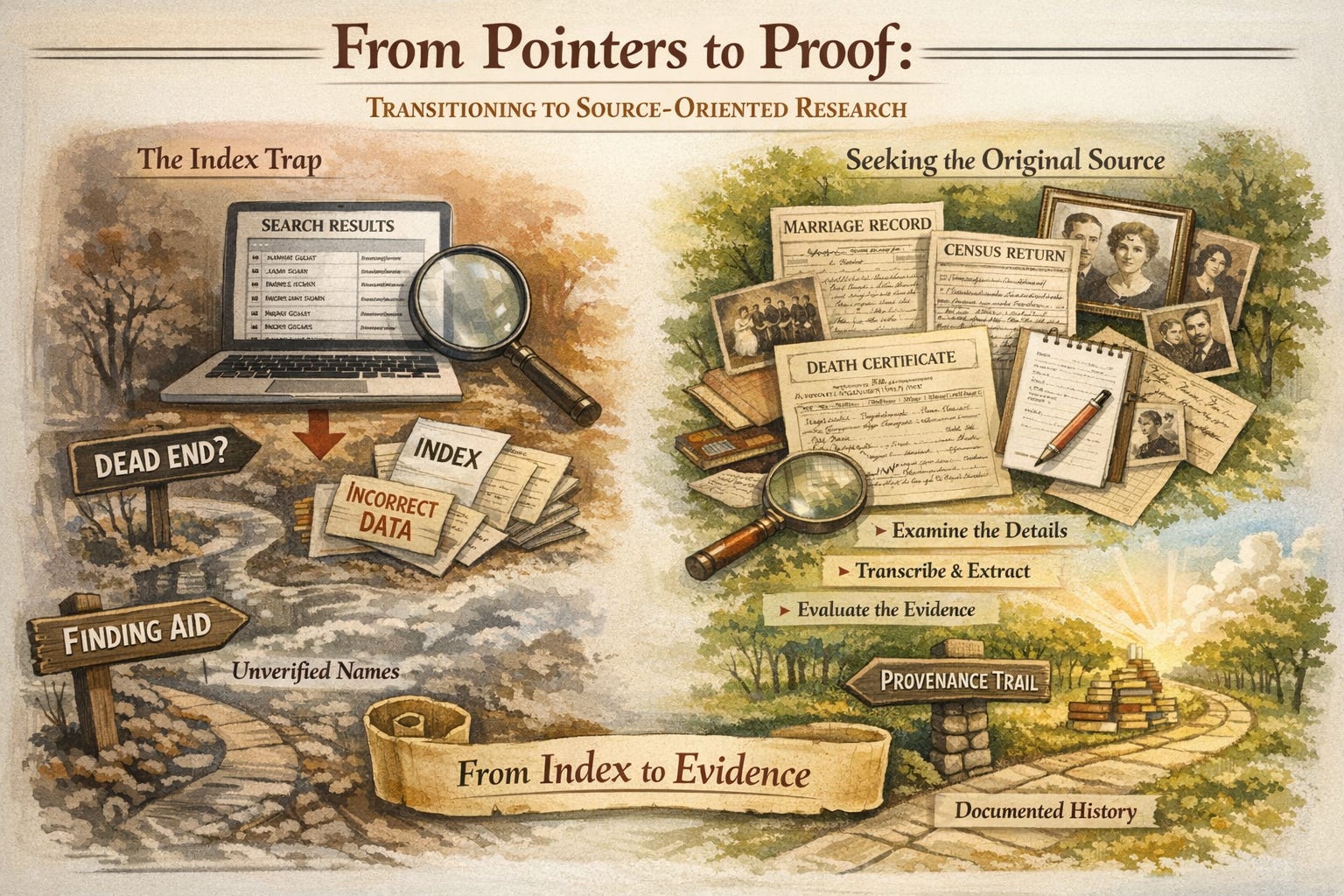
In the early stages of a genealogical journey, it is common to rely heavily on search indexes. The convenience of a search bar and a list of results is powerful; however, an index is merely a Finding Aid—a pointer designed to lead to a destination. To move from collecting names to building a verifiable family history, a researcher must transition to source-oriented habits.
This shift involves moving away from the “search and attach” method and toward a process of deep examination and critical analysis.
The Index Trap
An index is a derivative work. It is a transcription of an original record, often created by a human or an algorithm that may have misinterpreted handwriting, skipped lines, or omitted crucial context. Relying solely on an index means accepting someone else’s interpretation of the data without verification.
Step 1: Treat the Index as a Compass, not a Map
The first habit to develop is a mental shift: the index result is not the evidence; it is the invitation to find the evidence. When a search result appears, do not immediately add it to a tree. Instead, use the information provided (volume number, page number, or certificate ID) to locate the original record image.
Step 2: Examine the “Negative Space”
Source-oriented research requires looking beyond the specific name in question. When viewing an original digitized image, ask:
Who else is on the page? In a census, are there relatives living next door? In a marriage record, who are the witnesses?
What is in the margins? Notations about baptismal dates, physical descriptions, or references to other documents are rarely included in a standard index.
What is the “Informant” status? Does the record indicate who provided the information? A death certificate is a primary source for the date of death, but often a secondary source for the deceased’s parents’ names, depending on who the informant was.
Step 3: Transcription and Extraction
Instead of copying just a date and location, practice full transcription. Typing out exactly what the record says forces the eyes to see every word. This process often reveals details that were initially overlooked, such as “second marriage for both” or “naturalized in 1892.”
Step 4: Evaluate the Evidence
Once the source is in hand, evaluate it using the Genealogical Proof Standard (GPS). Does this source provide direct, indirect, or negative evidence? Negative evidence is the meaningful absence of an expected record or detail (for example, not finding a person in a census when they should appear). Does it conflict with other sources? A source-oriented researcher does not just look for “The Truth”; they look for the weight of evidence across multiple original documents.
Direct vs. Indirect Evidence (with examples) Direct evidence answers a specific research question outright. For example, if your question is “When did Sarah (Clark) Johnson die?” a death certificate stating her date of death provides direct evidence for that question. If your question is “Who are the parents of Michael Rivera?” a birth record naming his father and mother is direct evidence of parentage.
Indirect evidence requires you to combine details from one or more sources to reach a conclusion because no single statement gives the answer by itself. For example, a census might list a household that includes “John Smith, age 40,” “Mary Smith, age 38,” and “Anna Smith, age 12,” but never explicitly states that Anna is their daughter—yet the shared surname, age pattern, and household structure can support that conclusion when paired with other records. Similarly, a probate file that names several “heirs” without specifying relationships may become strong indirect evidence of a family group when you correlate it with deeds, vital records, and tax lists.
In practice, many tough problems (especially “brick wall” parentage questions) depend more on well-reasoned indirect evidence than on a single perfect record—so the key skill is correlation: assembling sources, noting conflicts, and explaining why your conclusion best fits the total evidence.
Step 5: Cite the Source, Not the Search Engine
A hallmark of this transition is the quality of documentation. A source-oriented researcher does not cite “Ancestry.com” or “FamilySearch.” They cite the original record found on those platforms: “1880 U.S. Census, Cook County, Illinois, population schedule, Chicago, Ward 4, enumeration district (ED) 12, page 15, family 102.” This ensures that any future researcher (including yourself) can return to the exact same image to verify the data.
The Reward of the Transition
The transition to source-oriented research is slower, but it is significantly more accurate. It is the most effective way to break through “brick walls” because those walls are often built on the shaky foundation of indexed errors. By centering the original source, you move from simply filling a tree to truly understanding the lives of the people within it.
I found it pretty ironic that we wrote about the same issue today!